
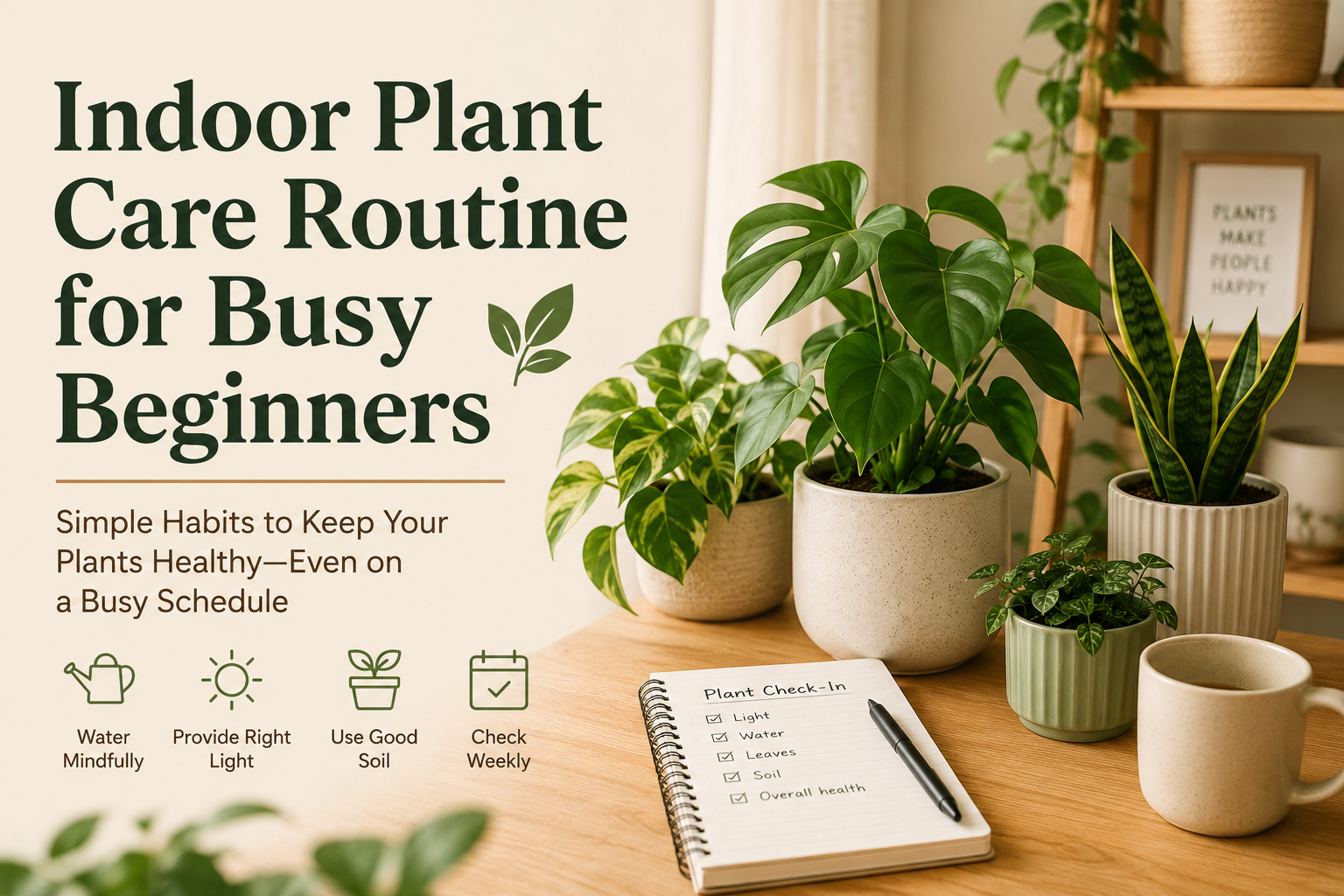
A useful indoor plant care routine starts with a quick look, not a list of chores to complete. For busy beginners, the aim is to reduce unnecessary checking while still meeting each plant’s needs. Set aside a few minutes once or twice a week to notice changes, then water, feed or adjust conditions only when there is a reason. The reminder is for looking; it is not a deadline for watering every pot.
Table of Contents
- Overview of a Simple Indoor Plant Care Routine
- Key Elements of Indoor Plant Care
- Watering Basics
- Light Requirements
- Soil and Fertilization
- Spacing and Pot Selection
- Time-Saving Tips for Busy Beginners
- Frequently Asked Questions
- How often should I water my indoor plants without overwatering?
- What kind of light do indoor plants need if I have limited natural sunlight?
- Can I simplify fertilizing and potting to save time?
Overview of a Simple Indoor Plant Care Routine
Starting with a straightforward routine makes plant care manageable, even with a packed schedule. Learn each plant’s basic needs first: how much light it needs, how dry its mix should become before watering, and whether it is actively growing. A short note beside the plant can save you from looking this up repeatedly. For those new to houseplants, the Indoor Plant Care Guide for Beginners: Everything You Need to Know offers supporting beginner advice.
Use your regular check-in to spot changes rather than repeat every care task. If a plant looks well and its conditions still suit it, you may have nothing to do. A plant drying quickly or recovering from a problem may need attention between check-ins; the routine should make room for that.
Key Elements of Indoor Plant Care
Understanding watering, light, soil and pot choice helps you decide when action is useful. These elements work together: the same plant may dry at a different rate after a move to a brighter spot or a change of pot.
Watering Basics
Each plant species has its own water needs. Watering also depends on the potting mix, pot size, light, temperature and plant condition. Some plants need moisture before the mix dries much; others need a longer drying period. A dry surface alone does not tell you whether the roots need water.
Check the mix at a depth appropriate to the plant and compare the pot’s weight with how it feels after watering and draining. Consider those clues together with the plant’s needs. If leaves droop while the mix is still wet, do not automatically add more water; look for the cause first. Overwatering can lead to root rot, so avoid leaving an ordinary nursery pot standing in collected water. Drainage holes let excess water escape, but cannot make an unsuitable watering routine safe. See How Often Should You Water Indoor Plants? A Beginner’s Guide for help judging when different plants need water.
Light Requirements
Light fuels plant growth. Choose plant-appropriate indirect light, checking the species’ needs rather than relying on which direction a window faces. The amount reaching a plant also changes with distance from the glass, curtains and outdoor obstructions. Low-light tolerant does not mean no-light: a plant still needs enough light to maintain growth.
Avoid direct, harsh sunlight unless the species suits it and has adjusted to that exposure. Observing a plant’s appearance and growth can help you notice when its placement needs review. If natural light is insufficient, a suitable grow light may help. Reassess placement when conditions change, rather than moving every plant at each check-in.
Soil and Fertilization
The choice of soil affects water retention, aeration and nutrient availability. Start with a potting mix suited to the plant. Perlite or pumice may help some mixes hold more air or drain differently, but add them only for a clear plant-specific reason. If the existing mix works well, there is no need to change it as part of routine care.
Before feeding, check whether the mix already contains fertilizer and how long that supply is intended to last. Consider whether the plant is actively growing and needs additional nutrients. Follow a suitable product’s label conservatively, including its dose and application guidance. Do not feed simply because a few weeks have passed, and do not use fertilizer as a quick fix for an unexplained decline.
Spacing and Pot Selection
Spacing can improve airflow, light access and room to inspect leaves and pots. Leave enough space to see the plants at the back and reach each pot without damaging foliage. Yellow leaves have several possible causes; crowding alone is not a diagnosis.
When selecting pots, consider size, drainage and material. Match the pot to the root system rather than choosing a much larger container to save future work. Terracotta pots often dry faster than plastic ones. Repot only for a clear reason, such as roots outgrowing the available space or a mix that no longer functions well. Drainage holes help water escape; they do not determine when repotting is needed.
Time-Saving Tips for Busy Beginners
Set one reminder for a quick visual inspection once or twice a week. Look for changed leaves, visible pests, unusual growth or water left in a saucer. When something needs a closer look, check that plant’s mix, pot weight and conditions before deciding what to do. Act on a reason, not on the reminder alone.
Group plants with similar light and moisture needs when practical, while leaving space for inspection. This makes care easier to organize, but each pot may still dry at a different rate. A brief note about a recent move or watering can help you understand changes without starting a detailed daily log.
Self-watering pots may suit some plants and mixes, but they do not automatically maintain ideal moisture. Monitor both the reservoir and the mix, especially while learning how the setup behaves. Moisture meters are optional and their readings are not always reliable. Use them alongside pot weight, mix condition and the plant’s needs, rather than treating a single reading as an instruction.
Frequently Asked Questions
How often should I water my indoor plants without overwatering?
There is no interval or surface-dryness rule that suits every plant. Match watering to the species, mix, pot size, light, temperature and plant condition. Use your check-in to notice whether closer assessment is needed, then consider moisture below the surface and pot weight before watering.
What kind of light do indoor plants need if I have limited natural sunlight?
Choose a plant that suits the indirect light available in your room, and check its specific requirements. Low-light tolerance does not mean it can live without light. If the spot is too dim, move the plant to a more suitable location or consider a grow light.
Can I simplify fertilizing and potting to save time?
Yes. Check for fertilizer already in the mix, consider active growth and plant needs, and follow the product label conservatively. Repot only for a clear reason, such as outgrown root space or deteriorated mix. Neither feeding nor repotting needs to be a fixed weekly chore.