
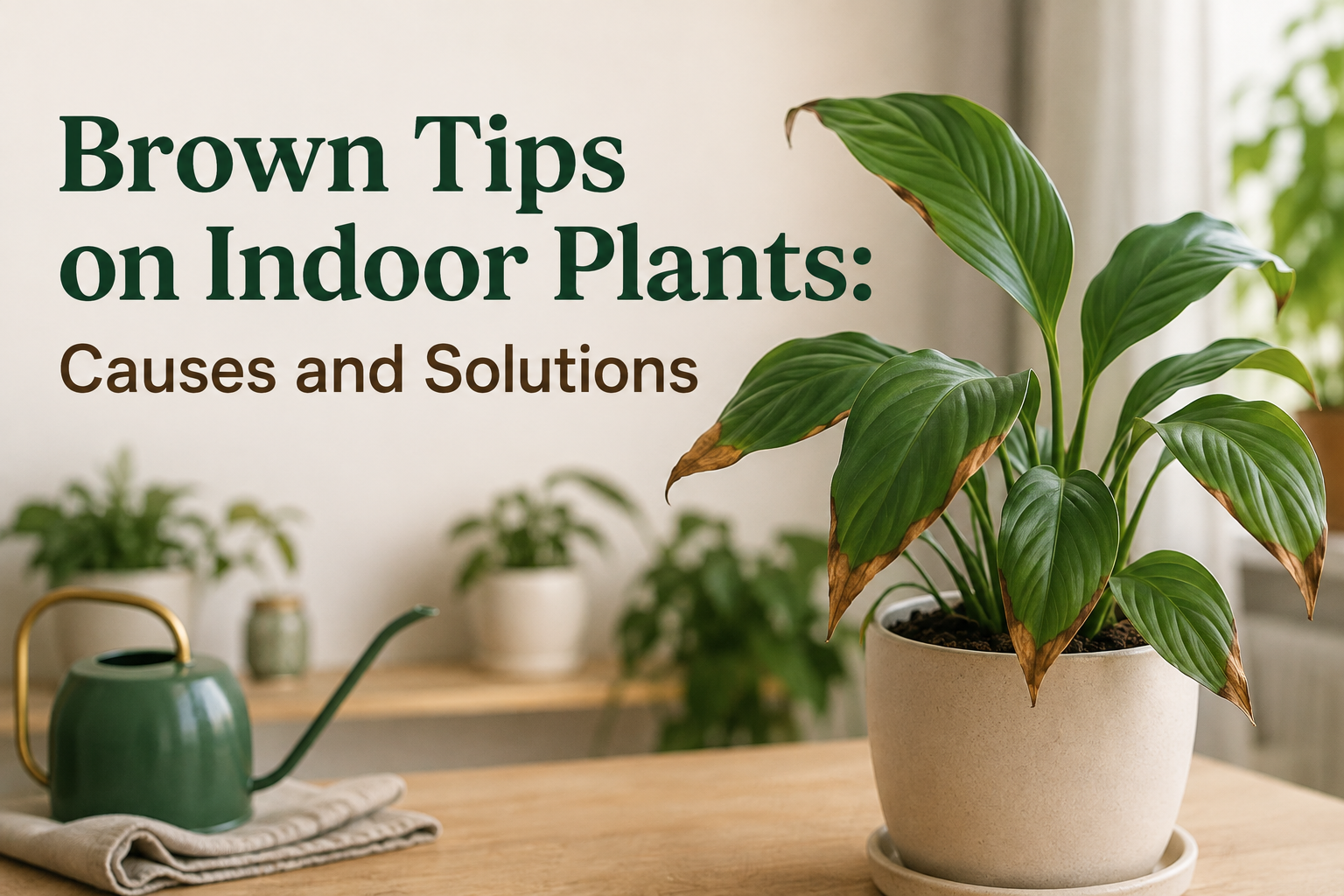
Brown tips on indoor plants are a common issue that can leave your greenery looking less vibrant and even cause worry about their health. These brown tips usually develop due to factors like inconsistent watering, low humidity, or mineral buildup, which can be confusing if you’re new to plant care. Understanding why these tips appear is the first step toward correcting the problem and helping your plants recover. This article will explain the main causes of brown tips on indoor plants and offer practical, easy-to-follow solutions to address them, so you can care for your plants more confidently and keep them thriving indoors.
Table of Contents
- Common Causes of Brown Tips on Indoor Plants
- Environmental Factors
- Watering Issues
- Nutrient Deficiencies
- Pests and Diseases
- How to Solve Brown Tips on Indoor Plants
- Adjusting Watering Practices
- Improving Humidity and Environment
- Proper Fertilization
- Dealing with Pests
- Frequently Asked Questions
- Why are the tips of my indoor plant leaves turning brown?
- How can I fix brown tips caused by improper watering?
- Can low humidity cause brown leaf tips, and how do I improve it?
Common Causes of Brown Tips on Indoor Plants
Brown leaf tips can appear for several reasons, often signaling that your indoor plant needs attention. Understanding the usual causes helps you identify the right care tweaks to prevent further damage. These causes generally fall into environmental factors, watering issues, nutrient deficiencies, and pest or disease problems.
Environmental Factors
Environmental stress is one possible cause of dry or browned leaf tips. Very dry indoor air may affect humidity-sensitive plants, especially near heating vents, while cold drafts and rapid temperature changes can place additional stress on foliage. Too much direct sunlight can also scorch exposed leaves. Check where the plant sits throughout the day, including nearby vents, windows, and changing sun angles, before moving it. A stable location with light and temperature suited to the species is usually more useful than trying to meet one humidity target for every houseplant.
Watering Issues
Both underwatering and overwatering can contribute to brown leaf tips. Soil that becomes too dry can leave a plant dehydrated, while persistently wet soil may reduce oxygen around the roots and interfere with normal water uptake. Check the soil condition, drainage, and recent watering pattern rather than diagnosing the problem from the leaf tip alone. Water quality is another possible factor, but it is not the default explanation. Some sensitive species may react to accumulated mineral salts or fluoride in their water, while many plants tolerate ordinary tap water without trouble. For more detailed advice, see How Often Should You Water Indoor Plants? A Beginner’s Guide.
Nutrient Deficiencies
A nutrient imbalance may contribute to leaf-edge or tip problems, but brown tips alone cannot confirm a potassium, calcium, magnesium, or other deficiency. Watering habits, fertilizer-salt buildup, humidity, root condition, drainage, and recent environmental changes should generally be checked first. Avoid adding fertilizer automatically in response to damaged tips, since extra salts can make the problem worse. If the plant has other signs of a nutrient issue, review its care history and use a fertilizer suited to that species only when feeding is appropriate.
Pests and Diseases
Pests or disease can sometimes cause damaged, discolored foliage, although a brown tip by itself does not identify either problem. Inspect both sides of the leaves, stems, and soil surface for insects, webbing, sticky residue, spreading spots, or soft tissue. If a contagious pest or disease seems possible, separate the plant from nearby plants while you identify the likely cause. Choose treatment only after that inspection, using a product labeled for the specific plant and problem when treatment is needed.
How to Solve Brown Tips on Indoor Plants
Start with the most likely care factors and change one thing at a time. Check watering and drainage first, then consider the plant’s light, temperature, humidity needs, fertilizer history, roots, and any signs of pests. This measured approach makes it easier to see which adjustment helps and reduces the risk of creating a second problem.
Leaf tips that are already brown, dry, and dead generally will not turn green again. The goal is to correct the underlying cause, limit additional damage, and watch for healthier future growth. Recovery time depends on the cause and the plant’s overall condition.
Adjusting Watering Practices
Begin by checking the soil in a way that suits the plant species rather than watering on a fixed calendar. Some plants should dry more deeply between waterings, while others need attention sooner. When watering is due, apply water evenly and allow the excess to escape through the drainage holes, then empty the saucer. A pot that drains poorly or soil that stays wet for too long needs attention before more water is added. If common watering, drainage, and environmental causes have been ruled out, owners of a sensitive species can investigate whether dissolved minerals or fluoride may be contributing. For broader watering and care guidance, see our Indoor Plant Care Guide for Beginners: Everything You Need to Know.
Improving Humidity and Environment
Very dry indoor air can contribute to tip damage in humidity-sensitive species, particularly near heating or cooling vents. First confirm that the plant actually prefers higher humidity and that watering or root problems are not the more likely cause. If the room air is consistently too dry, a room humidifier is generally more effective than a pebble tray or occasional misting. Keep foliage away from hot radiators, cold drafts, and abrupt temperature changes, and provide the type of light the species needs. Make environmental changes gradually, then watch new growth rather than expecting damaged tissue to recover.
Proper Fertilization
Excess fertilizer salts can accumulate in potting mix and contribute to tip burn, especially when a plant receives more fertilizer than it can use. Do not apply fertilizer simply because a leaf has a brown edge. Check watering, drainage, roots, light, and recent feeding first. When fertilizer is appropriate, choose a product suitable for the specific plant, follow its label, and consider whether the plant is actively growing. Start conservatively and avoid combining products or exceeding the labeled rate. If salt buildup is suspected, review whether the pot drains freely before considering a careful soil flush, since repeatedly saturating stressed roots can create another problem.
Dealing with Pests
Inspect the plant carefully before treating it. Spider mites, thrips, scale insects, and other pests leave different signs, so look at leaf undersides, stems, and nearby plants for insects, webbing, sticky residue, or patterned damage. If spread is possible, isolate the affected plant while identifying the pest. When treatment is needed, use a properly labeled insecticidal soap or another product appropriate for both the pest and plant, and follow the product label. Avoid improvised dish-soap mixtures or assuming that a broadly described natural remedy is automatically safe for every plant.
Frequently Asked Questions
Why are the tips of my indoor plant leaves turning brown?
Possible causes include watering stress, poor drainage, very dry air, excess fertilizer salts, root problems, harsh light, temperature stress, or pests. Check the plant’s recent care and growing conditions before choosing a fix.
How can I fix brown tips caused by improper watering?
Base watering on the plant species and the current soil condition rather than trying to keep every pot continuously moist. When watering is needed, water thoroughly, make sure the pot drains, and allow excess water to escape.
Can low humidity cause brown leaf tips, and how do I improve it?
Very dry room air may contribute to brown tips in humidity-sensitive plants. If humidity is genuinely too low for the species, a room humidifier is generally more effective than misting or relying on a pebble tray.