
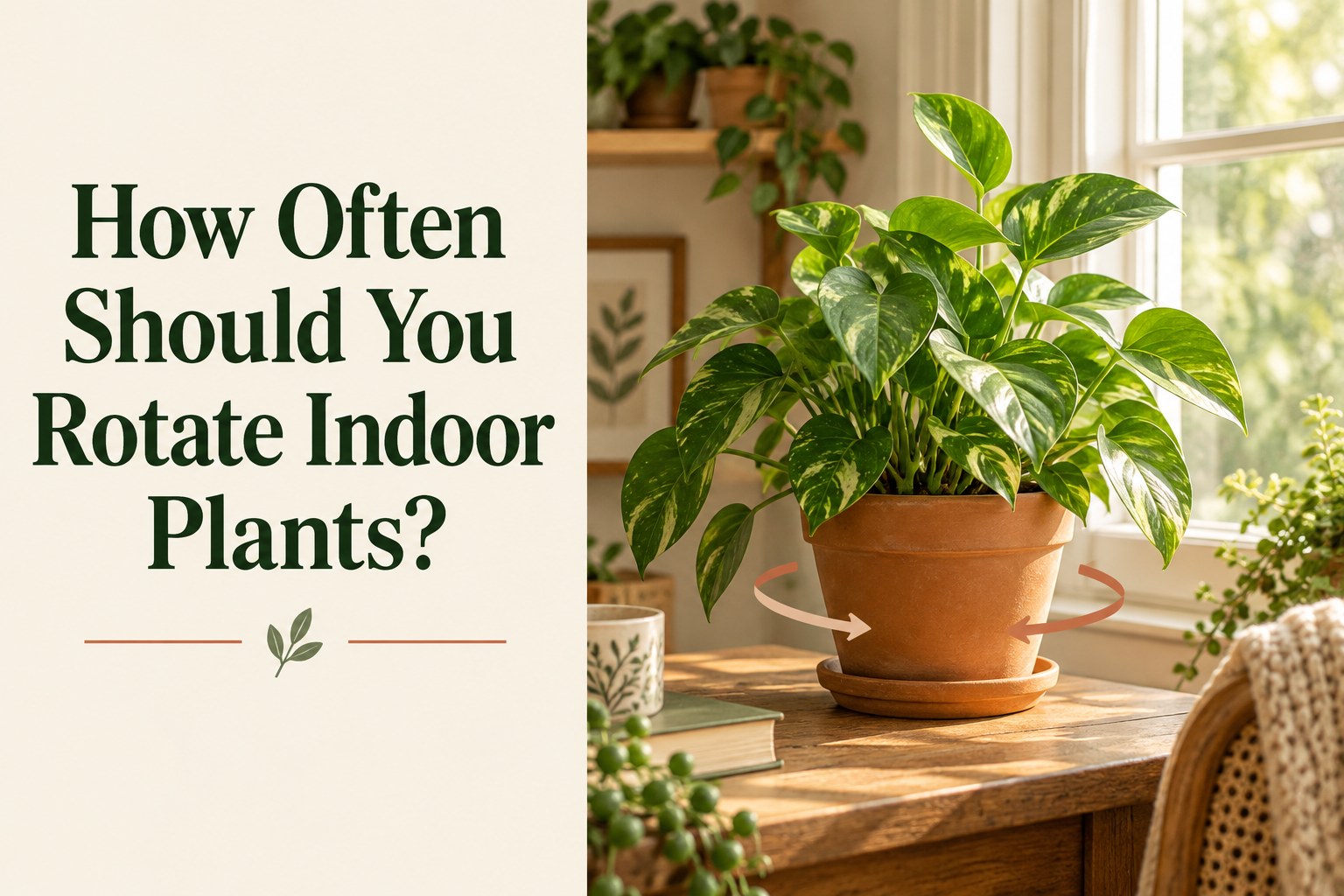
There is no universal schedule to rotate indoor plants. A plant beside a strongly directional light source may benefit from an occasional small turn if it grows unevenly, while one receiving balanced overhead light may need little or no rotation. Watch its growth and light exposure before deciding whether to turn the pot.
Table of Contents
- Why Rotate Indoor Plants?
- How Often to Rotate Your Indoor Plants
- Factors Influencing Rotation Frequency
- Signs Your Plants Need Rotation
- Best Practices for Rotating Indoor Plants
- Tips to Make Rotation Easier
- Common Mistakes to Avoid
- Frequently Asked Questions
- How do I know if my indoor plant needs to be rotated?
- Will rotating my indoor plants too often harm them?
- Can rotating indoor plants affect their watering needs?
Why Rotate Indoor Plants?
Rotation can help a plant grow more evenly when most of its light comes from one side. Leaves and stems often orient toward a strong light source, so a plant kept in the same position may become lopsided. A modest partial turn may help if you want a more symmetrical shape. Plants under relatively even overhead light may not need routine rotation.
How Often to Rotate Your Indoor Plants
Look at the direction of the light and the plant’s new growth. If one side consistently faces the brighter source and the plant begins leaning, a small turn may help distribute exposure. If it grows evenly, there is no need to turn it just because time has passed.
Rotation and watering are separate decisions. Check light direction and growth before turning the pot, and check root-zone moisture before watering. For help judging the latter, see How Often Should You Water Indoor Plants? A Beginner’s Guide.
Different plants respond differently to light. Observe your plant’s form and read the Indoor Plant Care Guide for Beginners: Everything You Need to Know for wider care context.
Factors Influencing Rotation Frequency
The main question is how directional the light is. A plant lit strongly from one side may gradually lean; a plant receiving balanced overhead light may stay even without turning. Window direction alone does not set a rotation interval.
Growth rate and plant form matter too. A fast-growing vine may reveal uneven growth sooner than a slow-growing plant, but neither needs a fixed rotation schedule. Look at new leaves and stems to decide whether a partial turn would be useful.
If growth is sparse or strongly stretched, check whether the plant receives enough suitable light. Rotation can change which side faces the source; it cannot make inadequate light sufficient.
Check the plant during ordinary care and turn it only when its light exposure or growth pattern gives you a reason.
Signs Your Plants Need Rotation
Leaning toward a window or fuller growth on the brighter side can suggest a response to directional light. These patterns are not proof that rotation alone will fix the plant. Sparse or pale growth can also have other causes, including insufficient light.
If the plant is markedly stretched toward a light source, consider whether its light level is suitable for the species. A turn may help future growth become more balanced, but existing stems will not necessarily straighten.
Uneven shading or a lopsided shape may make a gentle partial turn worthwhile. Observe new growth afterward rather than expecting an immediate change.
If one side has stayed shaded for a long time, avoid suddenly exposing it to much stronger direct sun. Turn gradually when strong sunlight could reach previously shaded foliage.
Best Practices for Rotating Indoor Plants
When rotation seems useful, handle the pot gently and choose a modest partial turn. Keep the plant in a suitable location and watch how new growth responds. There is no benefit to moving a plant that already receives even light simply to follow a routine.
Tips to Make Rotation Easier
Notice which side receives the strongest light and whether new growth is uneven. A small marker can help you track how a plant responds after a partial turn. Lift a heavy pot from its base, and avoid catching leaves on nearby objects. If the plant stretches strongly toward light, assess whether it needs a brighter location or suitable supplemental lighting rather than relying on more rotation.
Common Mistakes to Avoid
Frequent unnecessary repositioning is usually not helpful, and some plants may react to abrupt changes in light exposure or location. A full 360-degree turn returns the plant to its original orientation; use a modest partial turn if one is needed. Be careful with heavy pots and nearby leaves. If strong direct sun could strike foliage that was long shaded, change its exposure gradually. For more on deciding when to turn a pot, see How Often to Rotate Your Indoor Plants.
Frequently Asked Questions
How do I know if my indoor plant needs to be rotated?
Leaning or uneven growth may suggest directional light. A gentle partial turn can help balance future growth, but also check whether the overall light level suits the species.
Will rotating my indoor plants too often harm them?
There is no universal interval, and turning a pot frequently is not inherently harmful. Rotate only as needed based on directional light and uneven growth; avoid abrupt changes in location or strong sun exposure.
Can rotating indoor plants affect their watering needs?
Rotation itself usually does not meaningfully change watering needs. Continue checking moisture in the root zone and water according to the plant’s needs and growing conditions.